

Unfinished Spaces’: From luxury golf course to art school
Shortly after Fidel Castro and Che Guevara rose to power in 1959, they played golf at the once-exclusive Country Club Park on the western outskirts of Havana — and within driving distance of other former watering holes for Cuba’s elite, like Marina Hemingway and the Havana Golf Club.
Che, a caddy in his teen years, listened as Fidel — on a whim — said he wanted to build on that golf course “the most beautiful academy of arts in the world.”
The death of Cuban golf was the inspiration behind an 86-minute documentary called “Unfinished Spaces.”
The film, made over a 10-year period by independent American filmmakers Alysa Nahmias and Benjamin Murphy, was completed last year and screened in August month at New York’s Lincoln Center.
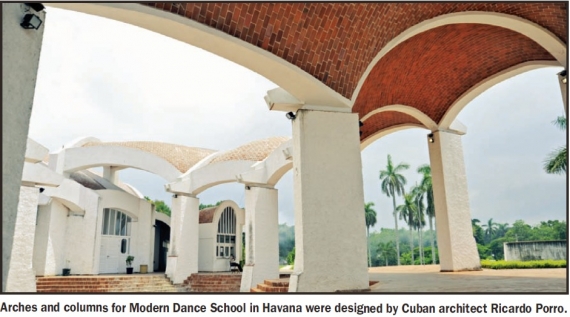
It chronicles efforts to convert the golf course into Cuba’s National Arts School (now known as Instituto Superior de Arte), which is famous for modern dance, plastic (visual) arts, dramatic arts, ballet and music.
When they began work in 1961, Cuban modernist architect Ricardo Porro and his Italian counterparts, Roberto Gottardi and Vittorio Garratti, grappled with the newly declared U.S. trade embargo against Cuba, which barred them from access to rebar and Portland cement from U.S. suppliers. This compelled them to use locally produced brick and terracotta tile materials to build the school; they also employed a Catalonian vault design to physically support these structures.
In 1965, Che and other technocrats halted the project for supposedly being at odds with the revolution.
Preference was given to Soviet-designed prefab buildings, since — unlike the arts complex, which had become too linked to the identities of the three architects — it was deemed more “revolutionary” to erect buildings that were nameless.
Ironically, during that time, one of the schools temporarily hosted a circus that entertained Russian military officials stationed in Cuba.
Porro eventually went into exile in Paris in 1967, while Garratti, who stayed in Havana, was falsely arrested on spying charges and expelled from Cuba in 1974; he moved his architectural practice to Milan. The third architect, Gottardi, remained on the island to teach architecture, but did little else.
Nahmias and Murphy managed to obtain film footage from Castro’s personal filmmaker to show what happened there afterwards: art students painting, ballet dancers in training (even on the rooftops), music students practicing their instruments, and would-be actors conducting performances.
A flurry of talking heads provided more details, such as architect and historian Mario Coyula, his New York counterpart John Loomis, Cuban diplomat Selma Díaz, famous Cuban actress Mirtha Ibarra, sculptor Kcho and painter Ever Fonseca.
“We tried to recreate the context in which these schools came from,” Murphy said after the Lincoln Center screening. “Hopefully, we’re able to tell the narrative story that was a part of others as well. To us, these interviews were an oral history.”
The filmmakers also showed the school during its periods of disrepair, ranging from vandalism to flooding. At one point, the jungle overran parts of the complex, making it resemble pre-Columbian ruins.
In the late 2000s, as Cuban Tourism Minister Manuel Marrero touted the building of up to 10 new golf courses, some feared that the arts complex could yet become a golf course again.
However, with help from Cuba’s Ministry of Culture, all three architects were invited to return to Cuba to restore the Schools of Plastic Arts and Dance, while the other three schools were cleaned and stabilized. Murphy notes that the complex still needs work. With funding still problematic, the architects are looking at outside sources for help.
“Vittorio has also been setting up a fund out of Italy to get more money for construction,” said Murphy. “It’s still true that [he] and Roberto [Gottardi] plan to create designs for what the restoration should be, and there are still organizations that very much want to help.”
Murphy hopes that more international exposure of his documentary will help raise non-U.S. funds to finish the other schools.
“Unfinished Spaces” airs on PBS nationally on Oct. 12, 2012, and is scheduled for a DVD release in April 2013.
Don't miss out
Become a Digital Subscriber and continue to access all the exclusive and insightful reporting you'll only find in Cuba News.
Subscribe Now - Get 30 days Free



Comments