

ASCE’s new president: Ted Henken
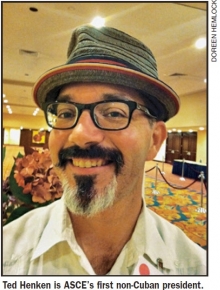
He’s the first president of the Association for the Study of the Cuban Economy who is neither Cuban-American nor an economist. How did sociologist and blogger Ted Henken pull that off?
Credit broad-mindedness, a love of hands-on learning and a gift for collaboration, associates say. Those traits are evident in the numerous books Henken is now working on: one with Canada’s Archibald Ritter on Cuba’s self-employed; another with a social-media expert in Spain on Cuba’s blogosphere, and all the while, co-editing and translating a Cuba primer written by Cubans on the island, including economist Oscar Espinosa Chepe and blogger Yoani Sánchez.
Henken took the helm of ASCE on Aug. 4 for a two-year term. He teaches at City University of New York’s Baruch College and chairs its Department of Black and Hispanic Studies. He pledges to open the association to scholars who neither specialize in Cuba nor economics, but can bring new insights to understand Cuba’s changing social economy.
ASCE started in 1990 when a group of mainly Cuban-American economists got together in the Washington, D.C., area. They aimed to foster research into ways Cuba might cope after the collapse of the Soviet Union and loss of hefty Soviet subsidies. The group grew to about 300 members in the late 1990s as Cuba revamped its economy.
But as Havana’s reforms cooled, so did membership. Some early members also retired. Today, membership stands at about 150, Henken said in an interview in Miami.
The challenge now, he told CubaNews, is to bring in a new generation of scholars to sustain the organization and its research. He’s optimistic, based on a wide definition of Cuba’s social economy, spanning everything from entrepreneurship to the ways ideas are exchanged.
Indeed, the 40-year-old embodies the new generation he seeks. Born in Pensacola, Fla., Henken mastered Spanish while working as an English teacher in Ecuador.
He took an interest in Cuba in 1995 doing work for Catholic Social Services in Mobile, Ala. His job: to help dozens of Cuban rafters who’d been picked up at sea and housed at Guantánamo naval base to re-settle in the United States.
Henken first visited Cuba in 1997 as a graduate student at Tulane University in New Orleans and has returned at least 15 times since then. He earned his doctorate in Latin American studies with a dissertation on Cuba’s self-employed, who at that time were “condemned to informality,” he said.
He’s drawn to Cuba’s entrepreneurs, he said, “because even though you can’t build an entire economy on them, the mom-and-pop store contains in it a practical and ideological riddle.” For Cuban communist stalwarts, the self-employed are both hated and needed. “It’s kind of like the United States with immigrants,” said the slim guayabera-glad scholar, sliding into one of his easy smiles.
Henken first came across ASCE in 1999 at a library while doing research and has attended nearly every ASCE summer conference since then. He often unveils work on his way back from Havana. While some elders in the organization have not wanted — or been able — to visit their Cuban homeland, Henken said he’s always felt “not only welcome but appreciated” in a group that values research, not ideology.
Don't miss out
Become a Digital Subscriber and continue to access all the exclusive and insightful reporting you'll only find in Cuba News.
Subscribe Now - Get 30 days Free



Comments