

Midwest drought further threatens U.S. food sales to Cuba
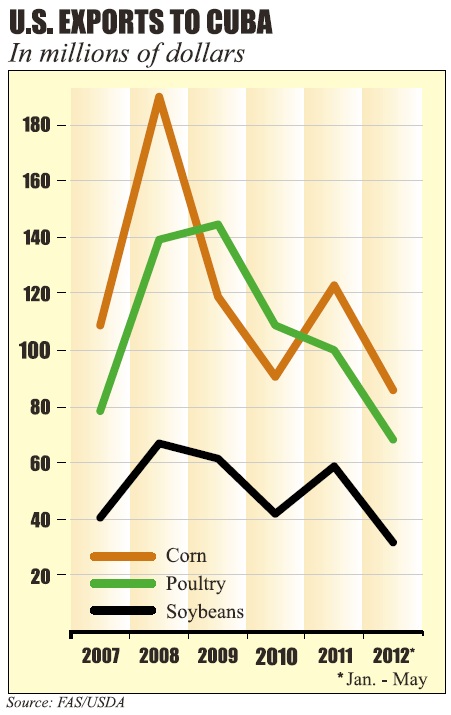
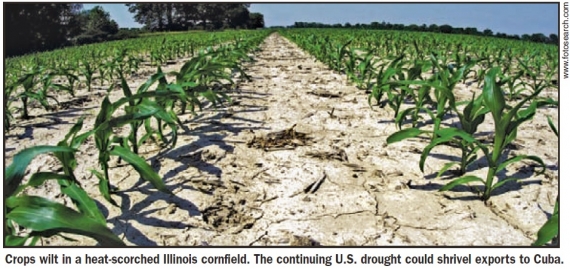
The extreme drought plaguing the American heartland has crippled production of corn, soybeans and wheat — all commodities favored by Cuban state purchasing agency Alimport for distribution among the island’s 11.2 million inhabitants.
According to Bloomberg News, the U.S. corn harvest is projected to fall to 11.8 billion bushels (about 300 million metric tons) this year. Given that the United States exports more than half its corn, a significant reduction won’t only crimp availability for overseas markets but will also force up prices for any processed foods that use corn or corn syrup.
Since feed corn is used to raise chickens, prices for frozen chicken — another leading U.S. export to Cuba — will also go up while supplies dwindle.
The USDA has reduced estimates for 4th-quarter 2012 broiler chicken production by 50 million lbs, while the 2013 estimate was lowered by 400 million lbs to 37.1 billion lbs.
Meanwhile, soybean futures are at record highs. The Chicago Board of Trade reports November 2012 prices rose 1.8% in mid-July to $16.49 per bushel, eclipsing the previous record of $16.37/bushel set in July 2008.
Whether Cuba’s Alimport will turn elsewhere for cheaper food is a matter of dispute.
“If the total supply [of corn and soybeans] available in the U.S. decreases substantially, as expected, then the world price for these commodities will also tend to rise, to meet the demand from countries unable to secure sufficient supplies in the United States,” said Larry Lieberman, president of Boston Agrex Inc., a longtime exporter of frozen chickens and other commodities to Cuba that is based in Norwell, MA. “This will therefore tend to reflect in the price of these products in Brazil, and therefore raise the input costs for Brazilian producers as well.”
In the end, Lieberman told CubaNews, Alimport will stick with U.S. chicken suppliers.
“While it may be that a fairly marginal percentage of total buying by Cuba of U.S. dark meat chicken may shift to Brazilian whole birds, I believe the price of U.S. dark meat chicken cuts vs. Brazilian whole bird prices will remain largely tilted in favor of the U.S. product on a per-kilo basis, albeit at a somewhat higher per-unit price,” he said. “Both countries’ prices will probably rise to some extent, in response to worldwide and domestic demand, but the price relation between the two will probably be fairly normal, and therefore the U.S. dark meat cuts will still be the better value on a per-kilo basis.”
Rising prices, however, may force Alimport to buy less imported food altogether, regardless of the source. A potential wild card for future U.S. agricultural sales to Cuba is other countries’ ability to provide credit.
“Argentina is the world’s second-largest corn exporter, but shipping costs for smallish volumes of corn from there to Cuba is much more expensive than from the U.S., because of the distances involved,” said University of Florida agriculture expert Bill Messina Jr.
“Now if Argentina were to offer Cuba credit, that could change the dynamic. Corn purchases have represented about 40% of Cuba’s total food and agricultural purchases from the U.S. over the last few years, so the issue is potentially significant in terms of overall U.S. exports to Cuba.”
Messina added: “Cuba will probably con-tinue to import some corn from the U.S. because we are close and reasonably competitive pricewise — but every time the USDA comes up with another estimate of production this year, the number keeps falling. And with prices going up, I don’t know how much they’ll be able to afford.”.
The Illinois Soybean Association, which visited Havana last May, already acknowledges that Brazil’s flexible trade policies are making U.S. soybeans less competitive in Cuba.
Doug Winter, the association’s treasurer, notes that Brazil extends Cuba a 60-day line of credit, which puts U.S. soybean producers like himself at a disadvantage, due to Washington’s requirement that Alimport buy from U.S. exporters on a cash-only basis.
“Prepaying for ag products can really put a business in a difficult cash-flow situation,” said Winter, speaking to the agribusiness publication FarmProgress.com following his group’s return from Havana. This is why the ISA is promoting Cuba’s inclusion in the Export Credit Guarantee program and other U.S. government credit initiatives.
The line of credit Winter referred to is the $400 million in financing that Brazilian President Dilma Rousseff announced for Cuba during her January 2012 visit to Havana.
Assuming Alimport isn’t doing this already, it may use that credit line to buy more Brazilian corn and soybeans — at the expense of U.S. suppliers — later this year.
Once U.S. corn becomes too pricey for Cuba, President Raúl Castro and Alimport officials may find themselves flying to Buenos Aires in the near future to negotiate a larger corn purchase from Argentine President Cristina Fernández — on credit, of course.
The U.S. Grains Council, another trade group that laments the “cash-only” terms of Washington’s food trade with Havana, said Cuba purchased 22% of its corn imports from Argentina, and 21% from Brazil, in 2011 — numbers likely to rise this year.
USGC’s regional director for Latin America, Kurt Shultz, says “although the U.S. still maintains over 50% of the market, the cash-strapped[Cubans] are looking to U.S. competitors in the South for their feed grain needs.”
Don't miss out
Become a Digital Subscriber and continue to access all the exclusive and insightful reporting you'll only find in Cuba News.
Subscribe Now - Get 30 days Free



Comments