

Crowley’s Jay Brickman: Pioneering U.S.-Cuba business
 Crowley Maritime Corp. executive Jay Brickman supervises his company’s Cuba operations.
He’s an unlikely candidate to become the dean of U.S. executives doing business with Cuba. Born in Mobile, Ala., to a Russian Jewish clan with no Latin American links, Jay Brickman might have stayed working with his family’s grocery business and never set foot in the Caribbean.
But, intellectually curious, Brickman took an early liking to Latin America. He mastered Spanish, earned degrees in international rela- tions and dedicated his career to the region — living for years in Mexico, Nicaragua, Venezuela and other Latin American nations.
Today, at 68, this perennial student holds the distinction of dealing with Cuba longer than any U.S. corporate manager active with the island. He starting visiting Havana in 1978 and continues to work with same company, Jacksonville-based Crowley Maritime Corp.
Oh, the stories he can tell — at least half a dozen sessions at the National Palace where Fidel Castro received business visitors from the late night into the wee morning hours; flights on old Russian planes; how even a phone book was tough to find during the “Special Period” after the Soviet Union cut off aid to Cuba, and of friendships forged with Cuban associates over the decades.
Crowley, with $1.5 billion in revenues and 4,500 employees worldwide, operates the largest U.S. containerized cargo service to Cuba. The shipping company sends down trailer loads of food and agricultural products, mainly U.S. poultry.
Crowley began the service in 2001 from Gulfport, Miss., and after Hurricane Katrina damaged that port in 2005, shifted to Port Everglades in southeast Florida.
Brickman estimates the company handles about 40 containers a week to Cuba, down from roughly 60 a few years ago when Havana spent more on U.S. food. It’s not much busi- ness, considering the same Crowley ship that unloads in Cuba continues on to Central America and often hauls down a full load of 1,000 containers on the trip.
“And where we have one ship into Cuba, we have five a week into Honduras,” he said.
Furthermore, Crowley takes back cargo to the States on its other routes, but can’t haul out Cuban freight under current U.S. law.
“Everything that goes into Cuba comes out empty. So that makes it very expensive to operate the Cuba service,” said Brickman. He estimated revenues on Cuba service in the “millions of dollars a year” but says profits are next to nothing. “We make very little.”
PATIENCE PAID OFF FOR THIS EXECUTIVE
Yet it’s more than today’s commerce that keeps Brickman coming back to Havana and grappling with often frustrating and bureau- cratic hurdles to business in both countries.
He imagines a time when the United States and Cuba trade freely and sees Crowley and his work as links to that future.
“There are windows in this great big world where you think you can make a little bit of a difference,” Brickman said. “You don’t often get that opportunity, and if you do, that’s kind of a privilege.”
Brickman said Crowley pursued business with Cuba starting 33 years ago, partly because its owners had bought assets that served the island before U.S.-Cuba trade halt- ed in the 1960s.
One of its ships used to take rail cars between West Palm Beach, Fla,. and Cuba. And a company it acquired even carried trail- ers from Key West south. “It could handle all of two containers at a time,” he said.
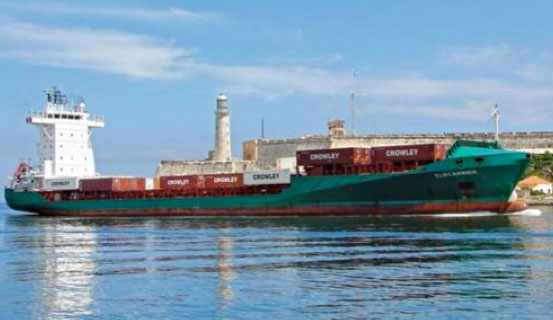 Crowley containership passes El Morro, a Havana landmark.
But starting up operations with Havana took decades, literally. Brickman said no busi- ness came from his 1978 visit nor from anoth- er trip in 1992.
Even after Pope John Paul II visited Cuba in 1998 and ushered in new relations, and after Congress allowed food sales to Cuba in 2000, it still took many meetings with U.S. officials in Washington and Cuban officials in Havana to iron out details for cargo service.
“Both sides have to give their approval before we can carry anything,” Brickman said. “It’s sometimes an arduous process, because we wait and wait and wait.”
Proof of the patience needed: Brickman said it took over two years until early May 2011 for Crowley to earn approvals to haul containers of freight sent by Cuban-Americans to their relatives on the island. Those goods now are either sent by air to Cuba, at a higher cost for the families. Or they’re shipped by sea to Panama and onward to Cuba, taking more time than Crowley’s direct sailing from Florida, he said.
FREE ADVICE: DO YOUR HOMEWORK FIRST
“We’ve been extremely persistent on this,” said Brickman. He figures Crowley can start the new shipments this summer, adding an initial four or five containers to Cuba a week but growing that business segment later.
Experts predict U.S. residents will ship lots more supplies south as Havana encourages Cubans to form businesses.
So, what advice would the dean give other U.S. companies looking to do business with Cuba?
“Just like any other market, ask: Do you have something they need, and can they afford it?” Brickman said. “If you don’t, you’re wasting your time and their time.”
If you have something that might sell, “it’s certainly worthwhile sitting down with the Cuban Interests Section in Washington to get some input from them and try to set up meet- ings through them,” Brickman said. “They’ve become somewhat of a gatekeeper.”
But if officials at Cuba’s mission in Washing- ton contact a ministry or agency on the island and staff there don’t want a meeting, then the Cubans probably won’t issue you a visa to visit the island, saving you a trip, he said.
Even if your product can sell, ask if you have the fortitude to navigate the tangle of laws, rules and changing winds of U.S.-Cuba relations. “Do you have the patience to under- stand?” he asked.
To sustain the effort, it also helps to have someone working on Cuba who is fluent in Spanish, understands Latin culture and is per- sonally committed to building relations with the island long-term —and “a company that supports that,” Brickman added. “You have to have a certain dedication.”
Brickman has watched many U.S. compa- nies stumble in Cuba over the years. Some see Cuba’s limited financial resources and underestimate the island’s well-educated and savvy professionals. Others buckle to the political influence of Cuban-American groups that oppose commerce with the island. Some seek returns too fast.
Brickman clearly enjoys the Cuba chal- lenge and keeps studying to better under- stand and contribute. At his Miami-area home he says “looks like a library,” he takes pride in more than 100 books on Cuba alone.
STAYING AWAY FROM POLITICS
Yet politics is a topic he definitely avoids. In a lengthy interview, Brickman never once mentioned the terms U.S. embargo or com- munist. He referred to the 2000 law authoriz- ing U.S. food sales to Cuba only by its acronym, TRSA for Trade Sanctions Reform Act, never using the word sanctions either.
“We have tried to be as apolitical as possi- ble in our business dealings,” Brickman said from the busy Bayside mall in downtown Miami where Crowley used to dock its ships when he started with the company and with Cuba back in the 1970s.
His approach when U.S.-Cuba politics get especially thorny: “In a rational way, you try to have a decent information flow, so at least there’s dialogue.”
Don't miss out
Become a Digital Subscriber and continue to access all the exclusive and insightful reporting you'll only find in Cuba News.
Subscribe Now - Get 30 days Free



Comments