


In June, two jailed British citizens Amado Fakhre and Stephen Purvis of Coral Capital Group Ltd. were found guilty by a Cuban court of minor charges and released for time already served.
Featured in Business & Economy
U.S. wood exporter hopes to supply Cuban housing sector
By Vito Echevarria
Cuba’s revived real-estate sector, energized by new laws that let citizens buy and sell property, will likely create a demand for U.S. lumber.
Economic reform: What to expect between now and 2018
By Domingo Amuchastegui
Two key figures in Cuba’s current leadership Vice Presidents Miguel Díaz-Canel and Marino Murillo Jorge have insisted, both privately and publicly, that the coming months will be “crucial” in defining Cuba’s economic reforms following the implementation of the Lineamientos adopted in April 2011 at the Sixth Party Congress.
ASCE urges faster, more comprehensive reforms to spark Cuba economic growth
By Doreen Hemlock
Can Cuba pull off Chinese-style reforms to achieve strong market oriented growth under Community Party control? Can Venezuela continue mass subsidies to the island?
Will Cuba’s micro-entrepreneurs build up small and mid-sized businesses that can truly propel the island economy forward?
Spain’s CECCE seeks open food market
By Vito Echevarria
A Madrid-based investment promotion group tells CubaNews it wants to get more involved with the Cuban economy by helping supply the island’s emerging small-business sector, including the so-called cuentapropistas.
Envoy: Mexican-Cuban ties will improve under Peña Nieto
By Vito Echevarria
Mexico’s up-and-down relationship with Cuba is now on a more secure footing than it’s been in years, claims Mexican career diplomat Roberta Lajous Vargas.
Speaking last month at New York’s CUNY Graduate Center, Lajous Mexico’s ambassador to Cuba from 2002 to 2005 said that with President Enrique Peña Nieto now in power, her country’s ties with Cuba will take a positive turn.
EU, Cuba move closer to accord
By Domingo Amuchastegui
The European Union expects to reach a “contractual framework” agreement with Cuba by year’s end, said a top EU official. To date, 14 of the EU’s 27 member states have signed cooperation agreements with the Cuban government.
Vivero Alamar offers insights into urban organic farming
By Ivet Gonzalez
The people are the only thing that matters,” says agronomist Miguel Ángel Salcines, who then lists a series of other “secondary” factors that have turned Vivero Alamar an urban cooperative farm on Havana’s outskirts into a rare success story in Cuba’s depressed agricultural sector.
Accused Cuba spy Marta Rita Velázquez hides in Sweden
By Tracy Eaton
A former State Department official accused of conspiracy to commit espionage for Cuba is now in Sweden, out of reach for now and refusing to talk.
Marta Rita Velázquez was a “talent-spotting” agent for the Castro regime, according to a 2004 indictment unsealed on April 26.
Toronto-based ICS now offers student internships in Cuba
By Vito Echevarria
The next time you check into a hotel in Havana, the front-desk clerk helping you just might be a student from Canada.
International Career Studies (ICS), a Toronto based firm that sets up overseas internships for Canadian and other foreign students, now has options to work in Cuba.
Illinois advocacy group pushes soybean exports to Cuba
By Vito Echevarria
A group of Illinois soybean farmers recently traveled to Cuba, where they saw with their own eyes how much business they’re losing because of the U.S. trade embargo.
In Havana, they met with officials of Cuban state food agency Alim-port to gauge the island’s current demand for soy-based products.
Cuban economy improves a bit, but data hard to come by
By Domingo Amuchastegui
Cuba’s economy will grow 3.7% this year, up from 3.1% in 2012, while the deficit will represent 3.6% of GDP in 2013, down from 3.8% last year (equivalent to 2.167 billion pesos).
Those are among the numbers released by Cuba’s National Assembly during its December session, which reported that most results fell short of 2012 goals. In particular, foreign investments came in 19% below target, mainly because of a slowdown in construction.
New entity Gecomex to oversee all import, export activity
By Vito Echevarria
Cuba’s Ministry of Foreign Trade and Investment (Mincex) has established a foreign trade entity called Grupo Empresarial del Comercio Exterior (Gecomex).
Part of Raúl Castro’s economic reforms, Gecomex is headed by Cuba’s minister of foreign trade, Rodrigo Malmierca. The new agency is aimed at improving the regulatory and managerial functions of Cuban import and export entities now under its umbrella.
U.K. retailers with Cuba products flee PayPal
By Vito Echevarria
An obscure pro-Cuba government solidarity group based in the United Kingdom, Rock Around the Blockade, has declared victory over U.S. online processor PayPal after fighting off attempts to block its website payment account.
Oil-dependent Cuba pursues renewable energy sources
By Domingo Amuchastegui
Dependence on oil is, in many ways, like a curse, and Cuba is no exception to the rule. For years, Cuba’s reliance on Soviet petroleum and more recently on Venezuelan oil led to a recurrent pattern of negligible efforts to find its own hydrocarbons, along with Moscow’s persistent refusal to engage in any serious drilling efforts.
Cuba unveils new reforms as GDP growth forecast drops
By Domingo Amuchastegui
Cuba announced July 8 it’ll begin deregulating its state-run companies in 2014, as the country expands its reform from retail stores and farming into more significant territory, said Communist Party top official Marino Murillo.
A new concept in Cuba: Paying taxes
By Vito Echevarria
Apr. 15 is a busy day in the United States as people from all walks of life race to finish their annual tax returns to both federal and state tax agencies.
In Cuba, though, the very idea of filing a tax return was non-existent until Raúl Castro’s reforms opened the door for self-employment.
Website finds jobs for talented Cubans
By Vito Echevarria
Cuba’s relaxed immigration law, which went into effect last January, and the elimination of exit visas for its nationals to travel overseas may very well trigger a gradual exodus of surplus labor from the island.
Council of Ministers discuss threats to Cuba’s economic health
By Domingo Amuchastegui
At a special meeting of Cuba’s Council of Ministers in early May, key leaders addressed some of the biggest long-term threats to Cuba’s economic health.
Adel Yzquierdo Rodríguez, minister of economy and planning, named three factors that keep the economy from expanding: continued losses and waste in state-run entities, the lack of necessary leadership by government investors, and the inadequacy of contracts among entities and institutions.
Naming of Díaz-Canel as first VP dominates Nat’l Assembly
By Domingo Amuchastegui
Cuba’s National Assembly met Feb. 24-25 to decide the course of its next five years. In so doing, President Raúl Castro’s closing remarks as well as the announcement of several new appointments caused considerable surprise.”
The biggest surprise was, of course, the selection of 52-year-old electronics engineer Miguel Díaz-Canel as first vice-president, replacing the elderly José Machado Ventura.
HughesNet cuts off satellite link for Cuban Internet users
By Vito Echevarria
Residents of Havana and other Cuban cities who were quietly using a U.S.-based broadband satellite link for clandestine Internet access suddenly found themselves cut off in late May, according to an entrepreneur who declined to be identified.
Envoy: Mexican-Cuban ties will improve under Peña Nieto
By Vito Echevarria
Mexico’s up-and-down relationship with Cuba is now on a more secure footing than it’s been in years, claims Mexican career diplomat Roberta Lajous Vargas.
Speaking last month at New York’s CUNY Graduate Center, Lajous Mexico’s ambassador to Cuba from 2002 to 2005 said that with President Enrique Peña Nieto now in power, her country’s ties with Cuba will take a positive turn.
BBG revamps efforts to ‘promote Internet freedom’ in Cuba
By Tracy Eaton
The Broadcasting Board of Governors has redesigned its strategy over the past two years, boosting efforts to promote Internet freedom and reach Cubans on mobile phones and social networking sites.
The BBG’s Office of Cuba Broadcasting operates Radio and TV Martí. The agency requested a budget of $23.5 million for fiscal 2013.
Cuban economist Torres Pérez: Slash education spending
By Vito Echevarria
Cuban academic Ricardo Torres Pérez bemoaned the state of Cuba’s socialist system and pushed for more reforms during a Feb. 28 speech at New York’s CUNY Graduate Center.
Torres Pérez, an economics professor at the University of Havana, calls for a number of unprecedented cost-cutting measures to spur along the reforms President Raúl Castro has already implemented.
One area he’d like to cut is government spending on education.
From the Business & Economy Archives
Cuba may sign long-awaited investment law next month
For decades, the Castro government has been pushing foreign investment for three obvious and “official” reasons: it provides capital, technology and markets. Add to that a fourth benefit: jobs.
Cayman executive discusses Cuba’s trade finance assets
Eric St. Cyr, CEO of Cayman Islands-based Clover Asset Management, has revealed the existence of “Cuban trade finance assets” in a recent column in the monthly Cayman Islands Journal newspaper.
St. Cyr, a Canadian national with extensive experience in the Canadian and Cayman financial sectors, said these financial instruments — generated by Cuban entities — are payment obligations “such as deferred payment letters of credit, bills of exchange and promissory notes payable at a future date.”
Cuba scholars meet in Miami to assess real impact of Raúl’s economic reforms
If Cuba ever found offshore petroleum in exportable quantities, would the island one day resemble democratic, squeaky-clean Norway — or impoverished, corruption-ridden Nigeria?
Even without any huge oil discoveries, is the growth of Cuba’s economy in the first decade of the 21st century really sustainable? What about prospects for economic reform under President Raúl Castro — should Cuba follow the Chinese model, the Vietnamese model or neither?
Havana’s new customs duties expected to slash Cuba-bound shipments, flights
Starting Sept. 3, Cuba will require its citizens to pay customs duties on imported goods in the dollar-like currency known as CUC instead of the island’s peso currency. That means the cost of duties will be more than 20 times higher and too expensive for many residents to afford.
National Assembly passes new tax code, other measures
Five reports were debated during this most recent session, which was closed to foreign journalists. The most important result was adaptation of Cuba’s first comprehensive tax code since the 1959 communist revolution.
Here are the session’s key achievements:
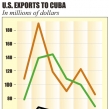
Midwest drought further threatens U.S. food sales to Cuba
According to Bloomberg News, the U.S. corn harvest is projected to fall to 11.8 billion bushels (about 300 million metric tons) this year. Given that the United States exports more than half its corn, a significant reduction won’t only crimp availability for overseas markets but will also force up prices for any processed foods that use corn or corn syrup.